★★★★★
“Had a great experience doing laser with Mary! Treatment was quick and professional. Worth the investment!”
Individual assessment. Two dual-wavelength laser platforms. Free consultation at Bloor or Yonge.
Aroma treats Fitzpatrick I through VI, including brown and deeply pigmented skin. Your plan is based on your current skin tone, recent tanning, hair colour and thickness, treatment area, medications, medical history, and previous skin reactions. Ethnicity alone does not choose the laser.
The direct answer
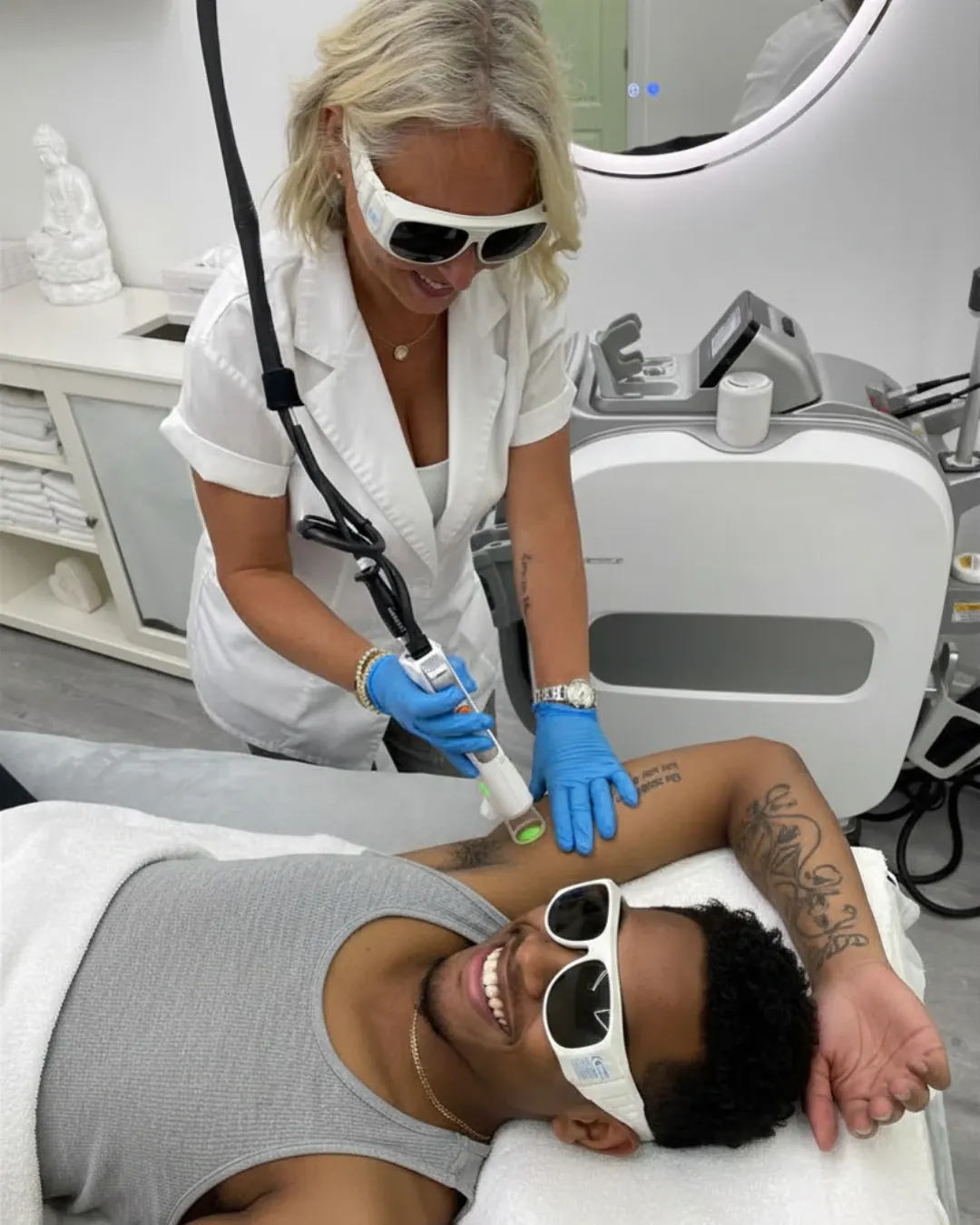
Yes, laser hair removal may be appropriate for darker and melanin-rich skin. The important part is choosing the device, wavelength, settings, cooling, and timing for the individual person.
Darker skin contains more melanin at the surface, so laser energy must be planned carefully. Nd:YAG 1064 nm is commonly selected for deeper skin tones because it is less strongly absorbed by surface melanin than shorter wavelengths. Alexandrite 755 nm is commonly used when the skin and hair contrast makes it appropriate. Neither choice is automatic, and no laser treatment is completely risk-free.
Every new laser client completes a consultation and test patch before the first full treatment.
Available on both Aroma laser platforms. Alexandrite is commonly selected for lighter skin and may be appropriate for some medium tones when the technician confirms enough contrast between the skin and hair. Recent tanning can change whether it is suitable.
Also available on both platforms. Nd:YAG is commonly selected for darker and more melanin-rich skin because its wavelength is less strongly absorbed by surface melanin. The technician still adjusts the settings, pulse, spot size, and cooling for the individual.
Toronto's diverse communities
Clients often search for laser information by ethnicity because they are concerned about skin tone, pigment changes, hair texture, or a previous experience. Those concerns are valid. However, people within every community have a wide range of skin tones and hair characteristics, so Aroma assesses your current skin, recent tanning, hair, treatment area, and history before choosing a wavelength or setting.
South Asian skin tones vary widely, from lighter to deeply melanin-rich. Your consultation focuses on your current skin tone, tanning response, hair colour and thickness, treatment area, and medical history rather than applying one setting to the whole community.
East Asian clients can also have very different natural skin tones, tanning responses, and hair characteristics. Hair pigment and thickness matter more to laser response than ethnicity itself.
Middle Eastern skin tones can range from lighter to olive, brown, and deeper tones. The wavelength is selected from your actual skin and hair assessment, not from your heritage or surname.
Clients with deeper skin tones often ask about burns and pigment changes. Aroma uses an individual consultation, current skin assessment, and required test patch before the first full treatment.
Latin American communities include a broad range of skin tones and hair types. A seasonal tan can change which settings are suitable, even when earlier sessions used a different approach.
European and Mediterranean clients may have very fair, medium, olive, or more deeply pigmented skin. Dark hair on lighter skin may provide strong contrast, while olive or tanned skin may require a different plan.
Your first appointment
We review skin tone, tanning, Fitzpatrick type, hair, treatment area, medications, medical history, tattoos, moles, and previous laser reactions.
A test patch is required before the first full treatment. It is usually done once, but may be repeated when circumstances change.
The technician decides how long to wait based on the area, skin, settings, and response. If the reaction is not suitable, the full treatment is postponed or declined.
Wavelength, settings, pulse, spot size, and cooling are selected for the individual and reviewed again at every visit.
Technology at each location
Clarity II provides Alexandrite 755 nm and Nd:YAG 1064 nm options with cryogen cooling. Mary performs laser services at the Bloor location.
Learn about Clarity IIThe Quanta platform provides Alexandrite 755 nm and Nd:YAG 1064 nm options. Stanka and Enza perform laser services at the Yonge location.
Cooling is used as part of treatment. Skin tone and recent tanning are checked before every session, and treatment may be adjusted or postponed when needed.
Risks and realistic limits
Darkening or lightening of the skin can occur after laser treatment. Proper wavelength selection, conservative settings, cooling, test patching, and sun precautions help reduce risk but do not remove it completely.
Laser creates heat in pigmented hair. Recent tanning, active irritation, unsuitable settings, or an unresolved skin injury can increase concern. Aroma may adjust, postpone, or decline treatment.
Very fine facial hair and blonde, red, grey, or white hair may not provide enough pigment for reliable reduction. Your technician will tell you when laser is unlikely to be worthwhile.
Hormonal hair growth may need more ongoing maintenance than non-hormonal body areas. Results and timing are discussed before you buy a package.
Read the PCOS Laser GuidePrivacy and comfort
Two Toronto laser locations
A consultation is required before a new client begins laser treatment. Booking ahead is recommended, and walk-ins are welcome when time is available.
588 Bloor St W, Toronto, ON M6G 1K4
Tel: 416-505-5222
2028 Yonge St, Toronto, ON M4S 1Z9
Tel: 416-901-1190
FAQ
Start with a consultation
Free consultation, required test patch, and an individual treatment plan at Bloor or Yonge.
Helpful Laser Links
Compare pricing, prepare for your appointment, and learn more about laser suitability, sessions, hair texture, sensitive skin, and PCOS.
Client reviews
Real Google review highlights from clients who mention laser comfort, professional care, and results.
“Had a great experience doing laser with Mary! Treatment was quick and professional. Worth the investment!”
“I decided to laser the Brazilian and underarm areas recently after 3 years of regularly coming to Aroma for waxing, and have had a great experience every time. Mary has been an absolute gem, and the sessions are thorough, painless, fun, and efficient! I…”
“I had an amazing experience at Aroma Waxing and Laser Clinic on Yonge, and I can’t recommend Enza enough. She is professional, knowledgeable, and makes you feel comfortable from the moment you walk in.”